
home  sheet music

RUFUS PERRYMAN - 'SPECKLED RED'
On October 23, 1892 Rufus Perryman was born as the second of eight or nine children to Henry Perryman and his wife Ada in Monroe, Louisiana. His father was a sharecropper. During Rufus' early years his family moved to Hampton, Georgia.
The family itself had only little musical background. William Lee 'Willie' Perryman, who is better-known as 'Piano Red' was Rufus' nineteen years younger brother. Their nicknames 'Speckled Red' (Rufus) and 'Piano Red' (William Lee) derived from both men being albinos. Both brothers had very poor vision, an effect of their albinism. They could never take formal music lessons, because both were cross-eyed and extremely near-sighted since birth, so each of them was a self-taught piano player and developed his barrelhouse style through playing by ear. Rufus was influenced by his idol Charlie Spand, along with James Hemingway and Will Ezell and also he learned to play the organ at his local church in Hampton, Georgia. As a teenager Rufus was already playing house rent parties and juke joints.
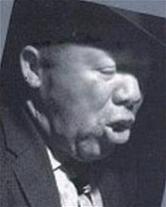
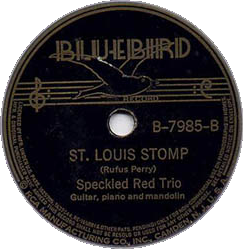
In 1925 Speckled Red left Hampton. It should last 35 years until he saw his brother William again. Speckled Red moved to Detroit where he played anywhere he could, including various nightclubs and brothels. In 1929 he left for Memphis, Tennessee, where he cut his first recording sessions for Brunswick Records resulting in two classics in Wilkins Street Stomp and The Dirty Dozens which became a hit in late 1929. In the following year he recorded a sequel, The Dirty Dozens, No. 2 in Chicago, Illinois, but it failed to become a hit. After Speckled Red's second set of sessions failed to sell, the pianist spent the next few years without a contract or label. He simply played local Memphis venues and St. Louis bars. In 1938, he cut a few sides with slide guitar player Robert Nighthawk and mandolinist Willie Hatcher as 'Speckled Red Trio' for Bluebird Records, including St. Louis Stomp and Welfare Blues, but they were largely unsuccessful. In the early 1940s Speckled Red settled in St. Louis where he continued his career of playing taverns, local clubs and bars for the next decade and a half.
Speckled Red's rugged blues and boogies had all the robust quality a good blues should have. He was most noted for his recordings of The Dirty Dozens, legendary exchanges of insults and vulgar remarks that have long been a part of African American folklore. Although Speckled Red and Piano Red and were brothers, they never recorded together. Maybe it was the result from the fact that the brothers were separated by almost a generation.
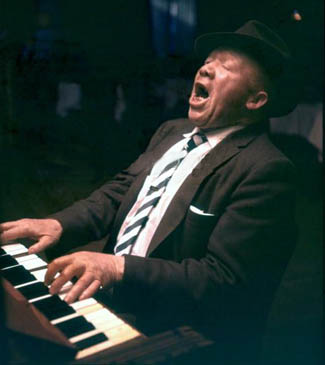
Speckled Red's rediscovery in 1954 was made possible by Charlie O'Brien, a police officer from St. Louis who applied his professional research methods to detect old blues musicians during the 1950s. In December 1954 Speckled Red subsequently was signed to the new Chicago based label Delmark Records as their first blues artist. During the late 1950s and 1960s he experienced a small revival of interest in his music. Several recordings were made in 1956 and 1957 for Tone, Delmark, Folkways and Storyville Record labels. He worked around the St. Louis-area jazz scene, regularly as the intermission pianist for the 'Dixie Stompers', performing concerts with 'Dixie Matinee' and the 'St. Louis Jazz Club'. 1961 he played the University of Chicago Folk Festival, went to Dayton, Ohio, with Gene Mayl's 'Dixieland Rhythm Kings' and even toured Europe in 1959 with Chris Barber. By this time, Speckled Red's increasing age was causing him to cut back the number of concerts he gave. For the rest of the 1960s, he only performed occasionally. Speckled Red died on January 2, 1973, of cancer in St. Louis, at the age of 80.
home sheet music